When you press the accelerator, your vehicle does much more than simply make the engine work harder. Power generated by the engine must travel through several components before it reaches the wheels. This network of parts is known as the drivetrain.
The drivetrain plays a critical role in transferring engine power to the wheels while maintaining traction, stability, and smooth vehicle operation. Among its most important components are the axles, driveshafts, and differentials. Each part has a specific job, and if one fails, overall vehicle performance can suffer.
Whether you drive a front-wheel-drive sedan, a rear-wheel-drive truck, or an all-wheel-drive SUV, understanding how these components work can help you identify problems early and make informed maintenance decisions.
Below is a detailed, pointer-based guide to the essential drivetrain components and how they work together.
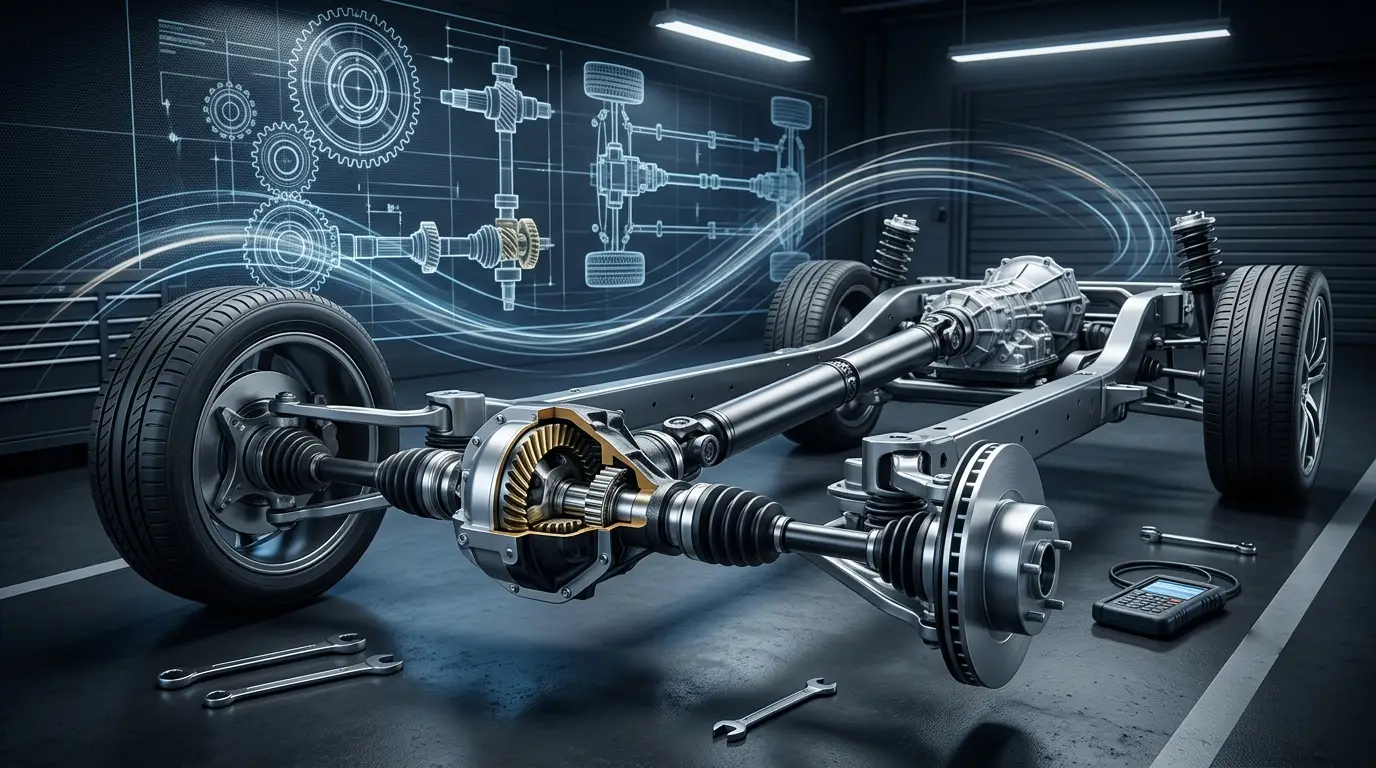
The drivetrain is the collection of components that transfer power from the engine and transmission to the wheels.
A typical drivetrain includes:
Think of the drivetrain as a relay team. The engine creates power, the transmission manages that power, and the drivetrain delivers it to the road.
Axles support vehicle weight and transfer torque to the wheels.
What Are Axles?
Axles are steel shafts that connect the differential to the wheels. Their primary job is to deliver rotational force while supporting the vehicle's weight.
Most passenger vehicles have two axles:
The type and number of driven axles depend on the vehicle's drivetrain layout.
Types of Axles
Live axles transmit power to the wheels, while dead axles mainly support weight.
How Axles Work
When power reaches the differential, it is distributed through the axles to the wheels, causing them to rotate.
Axles must withstand:
Common Signs of Axle Problems
Damaged axles should be repaired promptly to avoid loss of power delivery.
The driveshaft connects the transmission to the differential.
What Is a Driveshaft?
A driveshaft is a rotating tube designed to transfer torque from the transmission or transfer case to the differential.
Driveshafts are commonly found in:
Front-wheel-drive vehicles typically use transaxles instead of traditional driveshafts.
How Driveshafts Work
The transmission generates rotational force, which travels through the driveshaft to the differential.
Because the driveshaft rotates at high speeds, it must remain:
Universal joints or constant velocity joints allow the driveshaft to accommodate suspension movement.
Types of Driveshafts
The design depends on vehicle size, performance requirements, and drivetrain layout.
Common Signs of Driveshaft Failure
Ignoring driveshaft problems can lead to complete power loss.
Differentials help maintain traction during turns.
What Is a Differential?
A differential is a gear assembly that distributes engine torque between the drive wheels.
Its most important function is allowing wheels on the same axle to rotate at different speeds.
This is necessary because:
Without a differential, tires would drag and handling would suffer.
How Differentials Work
Power enters the differential through the driveshaft and pinion gear.
Inside the differential:
The result is smooth cornering and improved traction.
Open Differential
Limited-Slip Differential
Locking Differential
Electronic Differential
Common Signs of Differential Problems
Routine fluid changes help extend differential life.
The drivetrain functions as a complete system.
Here's how power flows:
If any component fails, power delivery is interrupted.
Each part relies on the others for efficient operation.
Different vehicles use different drivetrain configurations.
Front-Wheel Drive (FWD)
Rear-Wheel Drive (RWD)
All-Wheel Drive (AWD)
Four-Wheel Drive (4WD)
Understanding your drivetrain layout helps simplify maintenance and repairs.
Several factors contribute to drivetrain component wear:
Regular inspections help identify problems before they become expensive repairs.
Follow these best practices to extend drivetrain lifespan:
Preventive maintenance reduces wear and improves reliability.
Watch for these symptoms:
Early diagnosis can prevent extensive damage.
Your vehicle's drivetrain is responsible for turning engine power into motion. Axles, driveshafts, and differentials each play a critical role in transferring torque, maintaining traction, and ensuring a smooth driving experience.
Although these components are built for durability, they are subject to wear over time. Understanding how they work and recognizing early warning signs can help you avoid costly repairs and unexpected breakdowns.
Regular inspections, timely maintenance, and prompt repairs are the keys to keeping your drivetrain operating efficiently for years to come.
A differential allows the drive wheels to rotate at different speeds while turning, improving traction and handling.
Common signs include vibrations, clunking noises, squeaking sounds, and difficulty accelerating.
Axle damage is often caused by worn CV joints, torn boots, overloading, accidents, or rough driving conditions.
Service intervals vary by manufacturer, but many vehicles require differential fluid changes every 30,000 to 60,000 miles.
Driving with a failing axle, driveshaft, or differential can cause additional damage and create safety risks. Have the vehicle inspected as soon as possible.