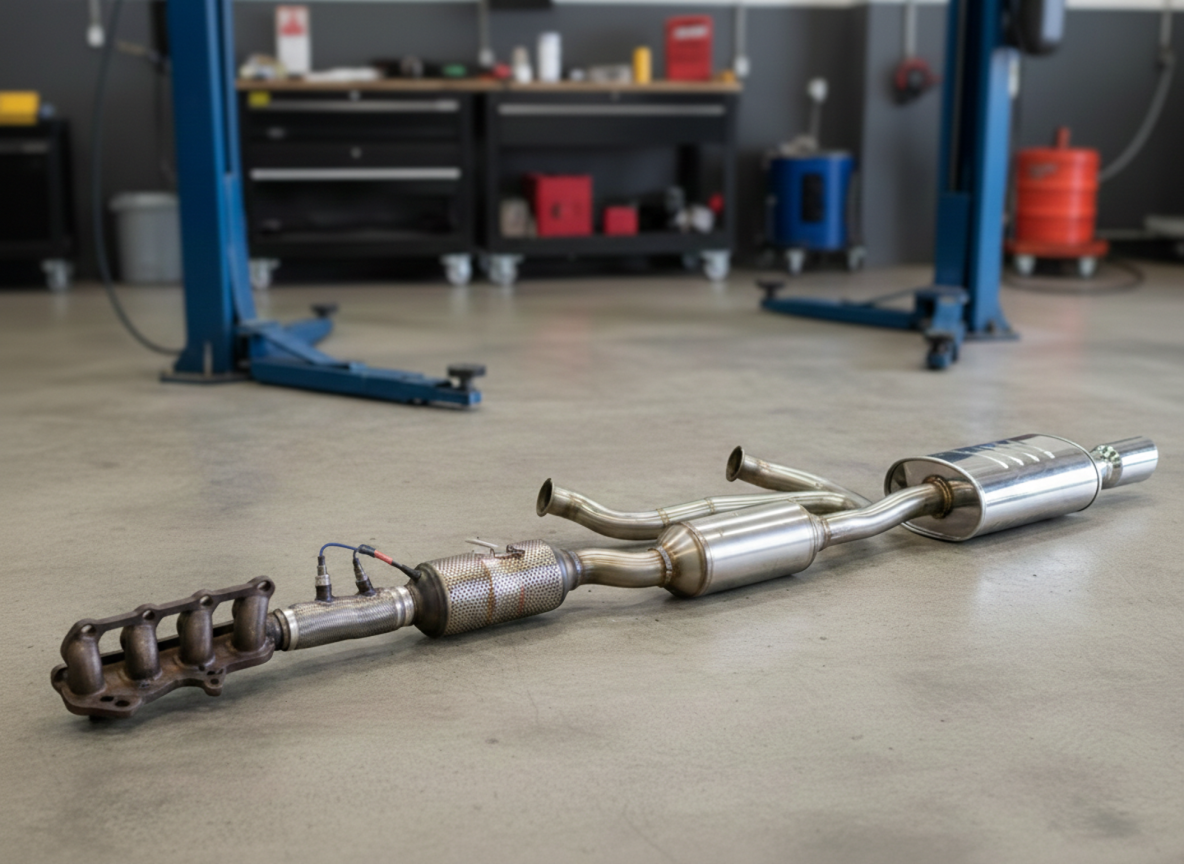
Most drivers don’t think about their exhaust system - until it gets loud. Suddenly your smooth ride sounds like a race car (and not in a cool way). But your exhaust system does far more than control noise. It manages harmful gases, improves engine efficiency, and even affects fuel economy.
From the exhaust manifold bolted to your engine to the muffler at the rear of your vehicle, every component plays a specific role. Think of the exhaust system as your car’s respiratory system. It expels harmful gases, controls pressure, and ensures the engine breathes properly.
Let’s break it all down, piece by piece, so you understand exactly what’s happening from manifold to muffler.
When your engine burns fuel, it creates exhaust gases. These gases include carbon monoxide, nitrogen oxides, and hydrocarbons - substances that must be safely directed away from the engine and cabin.
The exhaust system is responsible for:
Without it, your vehicle would be loud, inefficient, and unsafe.
The exhaust journey starts at the exhaust manifold.
Bolted directly to the engine, the manifold collects exhaust gases from each cylinder and funnels them into a single pipe. Since engines have multiple cylinders firing continuously, the manifold must handle extreme heat and pressure.
Cracks or leaks in the manifold can cause loud ticking noises and reduce engine efficiency.
Some performance vehicles use exhaust headers instead of traditional manifolds. Headers improve airflow and boost performance, but their purpose remains the same - collecting exhaust gases.
Right after the manifold, you’ll usually find oxygen (O2) sensors.
These sensors measure how much oxygen is present in the exhaust gases and send data to the engine control unit (ECU). The ECU adjusts the air-fuel mixture accordingly.
Why does this matter?
Because the right air-fuel balance improves:
A faulty oxygen sensor can reduce gas mileage and trigger a check engine light.
The catalytic converter is one of the most important parts of the exhaust system.
Its job is to convert harmful gases into less harmful substances before they exit the tailpipe. It uses precious metals like platinum and palladium to trigger chemical reactions that reduce pollutants.
Inside the catalytic converter, harmful gases are transformed into:
Without this component, modern vehicles would release significantly more pollution.
The resonator works alongside the muffler to control sound.
While the muffler reduces overall noise, the resonator tunes specific sound frequencies. It eliminates certain vibrations that create unpleasant tones.
Think of the resonator as a sound editor. It smooths out the rough edges before the exhaust note reaches the muffler.
Not all vehicles have resonators, but when they do, it helps create a quieter, more refined driving experience.
Exhaust pipes connect all the components, guiding gases from the manifold to the tailpipe.
They must:
Exhaust pipes are typically made of stainless steel or aluminized steel to prevent rust.
Leaks in the exhaust pipes can cause:
The muffler is what most people think of when they hear “exhaust.”
Its job is simple but critical: reduce engine noise. Inside the muffler are chambers and perforated tubes that reflect and cancel out sound waves.
Without a muffler, your car would be extremely loud.
There are different types of mufflers:
Each design affects sound level and performance differently.
The tailpipe is the last stop in the exhaust system. It directs exhaust gases safely away from the vehicle and passengers.
It may seem simple, but proper placement prevents fumes from entering the cabin.
Some tailpipes are purely functional, while others are designed for aesthetics and style.
An efficient exhaust system allows gases to flow smoothly. Restricted airflow can reduce engine performance.
Backpressure - the resistance against exhaust flow must be balanced. Too much backpressure limits power. Too little can reduce low-end torque.
That’s why performance exhaust systems are carefully engineered to optimize airflow without sacrificing efficiency.
Like any system exposed to heat and moisture, exhaust components wear out over time.
Common issues include:
Ignoring exhaust problems can reduce fuel efficiency and increase emissions.
Your car often provides warning signs:
If you notice these symptoms, it’s best to have the system inspected promptly.
While you can’t prevent all wear, you can extend the life of your exhaust system by:
Routine inspections during oil changes can catch problems early.
Some drivers upgrade their exhaust systems for better sound or performance.
Aftermarket exhaust systems may offer:
However, modifications should comply with local emissions laws.
Modern exhaust systems are designed to meet environmental regulations. Removing or modifying emissions components can lead to fines and failed inspections.
Maintaining your catalytic converter and oxygen sensors ensures your vehicle remains legal and environmentally responsible.
From the exhaust manifold to the muffler and tailpipe, every component of your exhaust system serves a purpose. Together, they control emissions, reduce noise, and support engine performance.
Understanding how these parts work helps you recognize problems early and maintain your vehicle more effectively. A healthy exhaust system doesn’t just keep your car quiet - it keeps it efficient, compliant, and safe.
When everything flows properly from manifold to muffler, your vehicle performs at its best while protecting both you and the environment.
It collects exhaust gases from the engine cylinders and directs them into the exhaust system.
It reduces harmful emissions by converting toxic gases into less harmful substances.
Its not recommended. Exhaust leaks can reduce performance and allow dangerous fumes into the cabin.
Many exhaust components can last 5–10 years, depending on driving conditions and climate.
Some performance exhaust systems can improve airflow and slightly increase horsepower, but results vary.